There is a statue in the south of France, in a chapel in Aix-en-Provence, where a small band of sick young men once knelt and prayed for the recovery of a priest dying of typhus. The priest was Eugene de Mazenod, a French nobleman who had buried much of his early life under disappointment, and the prayers of those youths marked his recovery. From that bedside, a missionary congregation was born. Two centuries later, a teenager from Barrie, Ontario, would walk into that same chapel on a youth pilgrimage and begin, without quite knowing it, to trace the founder’s footsteps as his own.
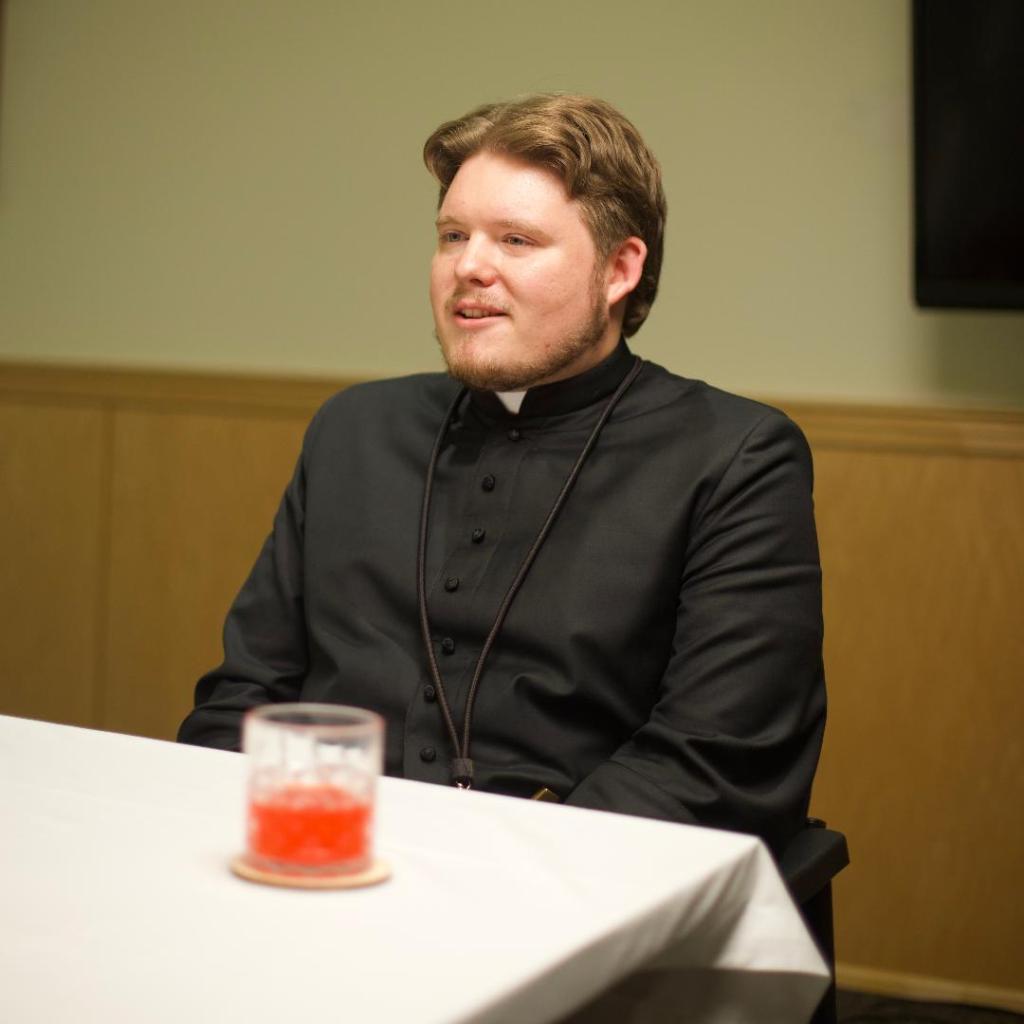
The teenager was Jonas Lalicz. Today he is Father Jonas, a Missionary Oblate of Mary Immaculate, ordained in 2024 at the age of twenty-six. His story is not the cinematic kind where a child announces at the age of two that he will be a priest. It is something rarer and, perhaps, more useful for the rest of us: a vocation revealed slowly, incrementally, the way dawn arrives rather than the way a light switch flips.
A Polish Inheritance
Father Jonas was born in Hamilton, the eldest of four and the only boy, into a family carrying the weight and the gift of Poland’s history. His parents were both physicians who met in medical school in Poland and chose to make their life in Canada. But the two sides of his family had arrived under very different stars. His father’s family had fled the communist regime, political and economic refugees seeking a better life. His mother’s family had stayed inside the system; her parents had even held membership in the Party, more out of security than conviction, and the faith in that household had grown thin and sporadic.
It was his father who first drew his mother more deeply into the faith, and she experienced something like a reversion of her own. That rekindled faith became the air the family breathed. Sunday Mass was non-negotiable, even on vacation in the Dominican Republic. And one constant anchored everything: Saint Maximilian Kolbe Parish, the Polish personal parish that had been home to the family for as long as anyone could remember. It was there, he would later say, that he was baptized, received every sacrament, experienced his conversion, and was finally ordained. Few priests can say their whole spiritual life unfolded under a single roof.
The Hand on the Chest
The first sign came when Jonas was eleven or twelve. On that Dominican vacation, his mother — who, by family legend, could “sniff out” a priest even in plain clothes — discovered that a fellow guest was a Polish pastor on holiday. She persuaded him to celebrate a Sunday Mass for the family before he flew home. At the end of it, the priest turned to the boy, placed a hand on his chest, and announced the intention he had been offering the Mass for: “for you to be a priest.”
The moment stunned everyone. His grandfather, no friend of the Church, was furious. (Years later, on his deathbed, that same grandfather would convert — a full-circle answer to the prayers Jonas never stopped saying.) And the boy himself? He reflected for two days, then buried the thought. He was not ready, and God, it seems, was in no hurry.
What did change him was mercy. About a year before his confirmation, Jonas had a profound experience in the confessional — an encounter with the mercy of Christ that left him with a peace he had never known. From that point his doubts about whether God was real simply dissolved. The faith stopped being an inheritance and became his own. While most boys drift from the Church in their high school years, Jonas drifted toward it, devouring early Catholic podcasts around 2012 and 2013, following Catholic content as YouTube and Instagram came of age, and traveling every Friday to the youth group in Toronto. His father, who knew from his own youth how much such a community could shape a soul, would leave work early and drive him down from Barrie, sometimes not arriving home until eleven at night.
Following Saint Eugene
The decisive call came in 2015. At a Mass in Parry Sound, a priest remarked that the Church needs more priests, especially from larger families. During that same Mass, Jonas felt with sudden clarity the real presence of Christ in the Eucharist. Two weeks later he was on pilgrimage in France, at the cradle of the Oblates, retracing the life of Eugene de Mazenod. A day of silence under the guidance of the Oblate vocations director cracked something open, and the thought he had buried at eleven began to grow and would not stop.
Only in recent years has Father Jonas recognized how thoroughly his life rhymes with his founder’s. Eugene was the only son. So is he. Eugene knew the ache of a fractured family and a distant mother figure, and was rescued by an encounter with the crucified Christ on a Good Friday — mercy received, then mercy given to prisoners and the poor. Jonas, too, was remade by mercy in the confessional, and the joy of his priesthood now flows from the other side of that grille. “Hearing confessions,” he says without hesitation, is the greatest joy of his vocation, because that is where he first met the Lord.
Formed in Fire and Fog
The road was not gentle. At eighteen, freshly out of high school and deeply rooted in a family he loved, Jonas left for Poland. The novitiate sat atop Holy Cross mountain, the oldest sanctuary in the country, wrapped much of the year in low cloud and fog — a place he found genuinely difficult after a life of Canadian sunlight. There were nights he wasn’t sure he should stay. Then a phrase would arrive in the silence — Come, follow me — and he would resolve to give it one more year. The years kept compounding.
After first vows came two years of philosophy in the Polish village of Obra, then theology in Rome, where he lived in an international community drawn from nineteen different countries. The friction of so many cultures taught him the lesson he now names as the great temptation of the spiritual life: the pride of believing we already have all the answers, and the question of where, in such a heart, there is any room left for God. As Oblates, he and his brothers profess the usual counsels of chastity, poverty, and obedience — plus a distinctive fourth vow of perseverance.
Before his ordination, he spent six months as a missionary in Cuba, in a hurricane-battered town in the tobacco country of Pinar del Río, where the obstacle was rarely money and often the simple impossibility of obtaining cement or decent paint. There he learned to lean entirely on his brother Oblates, the only people he could fully trust.
“Am I Weak Enough?”
For years, Jonas asked himself whether he was worthy of the priesthood. He has since decided it was the wrong question. His superior general put the right one to a group of newly professed: not am I worthy, but am I weak enough — empty enough to be filled with God.
On August 22, 2024, in the parish that had held his whole life, Cardinal Francis Leo laid hands on him. People came from as far as Ottawa. He hugged parishioners until nearly midnight, slept poorly, and woke a priest with a Mass to celebrate. His advice to the young men now coming to him as vocations director is the distilled fruit of that long, unhurried road: seek silence, because that is where God still speaks, and pray thy will be done — not bringing the Lord your own plans, but staying open to what He wants to give, even when it frightens you.
“God sees something we don’t see,” Father Jonas says. He planted something none of us can fully name. We watch it come to life only as we keep answering the call.