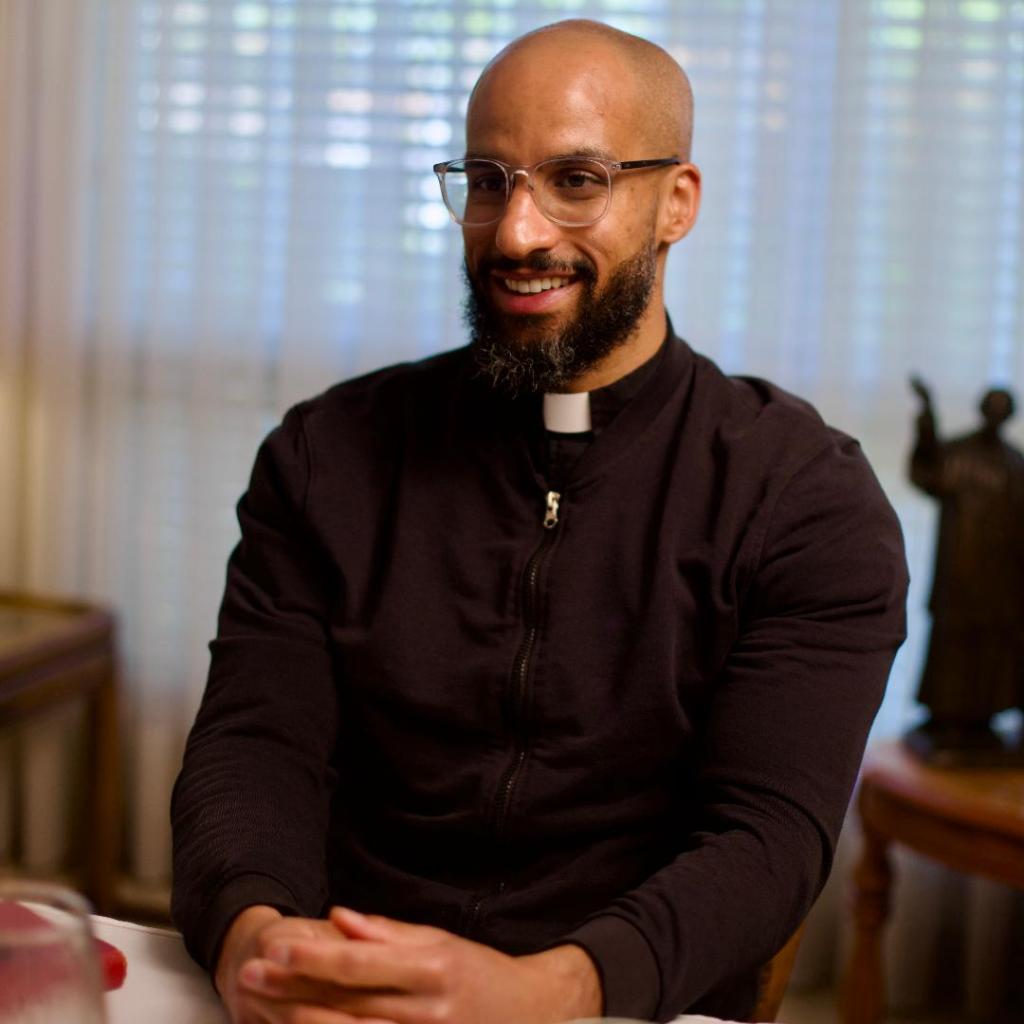
On a frozen lake in Muskoka, in the dead of winter, a sixteen-year-old boy looked up and saw the whole sky. He had come on an overnight trip with his high school outdoor club, and late one night a staff member had knocked on the cabin door and invited the group on a surprise midnight hike. They walked out in pitch dark, chatting, careful not to lose one another, until they reached the middle of the lake and were told simply to look up. There were stars there of a kind you never see in Toronto — no light pollution, the night sky perfectly clear and immense. And the boy thought: if something this beautiful exists, there has to be a creator. And I want to know him.
Only years later would he learn the line from the psalm — the heavens declare the glory of God — and recognize it as a description of exactly what had happened to him on the ice. The boy was Brandon Gordon. Today he is Father Brandon, a Salesian of Don Bosco, ordained three years ago and serving the parish of Saint Benedict in north Etobicoke, the same corner of the city where he grew up. His story is one of a seed planted early and almost forgotten, that took the better part of two decades to germinate.
Culturally Catholic
Father Brandon describes his family as “culturally Catholic” — and he means it as something more complicated, and more hopeful, than the phrase usually suggests. His father is Afro-Jamaican, born and raised in Kingston; his mother is Italian and Irish, born in Canada to a Sicilian family that had lost the faith somewhere along the way. When he once asked his grandmother in Jamaica why she had a few of her children baptized despite never being a churchgoing woman, her answer was bracingly practical: baptism opened the door to the local Catholic school, the best educational opportunity available in very difficult circumstances.
So Brandon himself was baptized at eight months, “just because it was a cultural thing to do,” and received his sacraments through Catholic school after starting at Saint Dorothy in grade three. There were no prayers at home, no Sunday Mass. But the seed was there. His great-grandfather, a Sicilian immigrant who shared their house, kept images of the Sacred Heart and Padre Pio and watched the Pope’s Wednesday addresses on television — a devotional, cultural faith rather than a practiced one. And the boy, paging through the picture Bibles his parents had given him, would look at the wine and bread on the family table and quietly connect it to the Last Supper. A primitive spirituality, he calls it, in a child who was not raised religious at all.
It is a point he insists on as a priest: that “culturally Catholic” is not an insult. Without his grandmother’s pragmatism, without that priest who signed the baptismal paper despite every reason to doubt the child would be raised in the faith, there would have been no seed to germinate. He teaches baptism classes now, and his first words to non-practicing parents are always the same — thank you for being here; this is a great step; one step at a time.
A Sandlot Childhood
Before any of that bore fruit, Brandon was, by his own description, a street kid — home only to eat. He and the neighborhood children dragged a portable net onto a bend in a side street and spray-painted baselines that lasted all summer, one boy on lookout for the cops while another painted. They organized full nine-on-nine baseball games and never went to summer camp because they had built their own. Nights were hide-and-seek, manhunt, and walks through the cemetery. His main sport was baseball — shortstop, then center field after some elbow tendinitis, fast enough to single and steal second every time. His father coached.
By high school he had it all by worldly standards: good grades, popularity, athletics. And yet he began to sense that something was missing. The things the world said would make him happy did not produce any lasting happiness. What did stir him was beauty — National Geographic with his dad, long hikes in the West Humber valley, the design and peace of the natural world — and beneath the beauty, a growing desire to meet the artist behind it. As he puts it, seeing a masterpiece in a museum makes you want to know the one who made it, to trace the work back to its source.
The Question He Asked Himself
The hunger sent him, remarkably on his own, to make an appointment with a priest in high school. It also sent him into a serious study of the world’s religions. He read the Dao De Jing and loved it, seeing in the Dao a foreshadowing of the Logos. Buddhism appealed to his philosophical side — the paradoxical Zen stories, haiku, Japanese art. Islam drew him with its discipline of daily prayer and fasting. He gave genuine, serious thought to each.
But each left him wanting the one thing the stars had awakened in him: to know the artist personally, to put a face to God. So one day he asked himself a simple question — if I were God, how would I reveal myself? Not, he decided, through enlightenment, and not only through a book. He would become human. He would live among people and teach them about himself, perform miracles to prove who he was, lay down his life in the ultimate act of love, and rise from the dead to show his power over death. And then the light went on: that is exactly what Jesus did. Everything in the old picture Bible turned out to be right.
Knowing it in the mind and living it in the heart were two different things. Borrowing a phrase from the legendary Salesian Father Frank Kelly — that the vastest distance in the universe is between the head and the heart — Brandon admits the truth took three or four years and a great deal of stumbling to make that descent. Around nineteen or twenty, midway through a philosophy degree at York, he simply decided to go to confession and start going to Mass every Sunday.
“I Can’t Compete with God”
A vocation began to echo almost immediately, but he doubted it — convert’s zeal, perhaps. He tried the alternative, dating a young woman for a few years, a good person he remains grateful to. But the restlessness would not leave. The nightclubs and worldly outings stopped giving him joy; he wanted to stay in and read the lives of the saints. She sensed it before he fully did. One night she turned to him and said, I can’t compete with God. It hit him like a ton of bricks.
His first instinct had been monastic — he is, despite all his talking, deeply introverted and studious, drawn to the Desert Fathers and a romantic vision of the wilderness. But what he kept returning to was his love of working with young people, and in the Salesians of Don Bosco — founded in 1859 in Turin by a saint who drew street children in through games and magic tricks before teaching them the faith — he found his own life’s mission named: to seek out other young people living on the spiritual periphery, culturally Catholic and never quite invited deeper, and to bring them in.
His mother, hoping for a teacher and grandchildren, took it hard, moving through shock and anger and bargaining. His happy-go-lucky father assumed it was a phase — until a video call months into the novitiate in Los Angeles, when he broke down and cried. His private younger brother said flatly that he didn’t believe. So Brandon resolved to stop preaching and simply pray, offering up the homesickness of ten years of formation for his family. He returned from his first profession to find his brother had tattooed the face of Christ, crowned with thorns, on his shoulder.
On Mount Tabor
Ordained in New Jersey by the Salesian Cardinal Óscar Rodríguez Maradiaga — with both his parents present together for the first time — Father Brandon lay prostrate during the Litany of the Saints and felt not alone but surrounded, a cloud of witnesses rooting for him. He was famously stoic through it; his classmates teased that he must be a robot. The reality landed instead at his Mass of Thanksgiving, when he experienced the celebration almost in the third person — hearing himself speak the words and knowing the Holy Spirit was acting through them. That week, on vacation, he celebrated Mass in his parents’ nineteenth-floor apartment, looking out the window at the very streets where he had grown up. He felt, he says, like he was on Mount Tabor.
He finds his greatest joy now in something he did not expect: the trust people extend to him simply because he is a priest — not for his sake, he is quick to say, but because of who he represents. His advice to young people who feel the same hunger he once did is concrete. Get a spiritual director, because the one who guides himself is the blind leading the blind. Build a disciplined life of prayer. And treat every Friday like Lent, because, as he likes to say, prayer knocks and fasting obtains.