Andrew was a tall boy, and tall boys have a habit of looking down at things. Not arrogantly, mind you, but literally. From his height the pews of the chapel at his school appeared smaller, the books in his hand appeared closer, and the people who had told him about God appeared, all at once, a great distance away. He had been raised by parents who could explain the faith the way a good carpenter explains a joint: not as a mystery to be guarded, but as a thing that fit together because it was made to. They had given him reasons. They had given him good ones. And now, in the curious treason of adolescence, he was discovering that the reasons of his parents, however excellent, were not yet his own.
He loved the sciences. This is important. He did not drift toward doubt, as some boys do, by way of indolence or appetite; he drifted toward it by way of wonder. He had looked at the long careful columns of the natural world and found them beautiful, and he had then made the very natural mistake of supposing that the men who measured those columns must therefore have measured everything else. He met scientists who were brilliant and certain, and brilliance and certainty together have always been one of the strongest wines a young man can drink. For two years he drank it. For two years he asked, quite honestly and quite alone, whether the faith of his childhood was anything more than a warm room he had been born inside.
It is fashionable to suppose that a boy in such a state will be argued out of his religion by some clever book, and argued back into it by some cleverer one. Andrew read the clever books. He found them, in their way, formidable. But the thing that troubled him was not what the clever books said; it was what they could not say. They could describe the stars and they could not describe a quarrel. They could weigh the brain and they could not weigh a regret. They could account for everything in a man except the only things a man ever lies awake about.
For Andrew had begun, almost without meaning to, to watch people. Not to judge them, you understand. Simply to watch. He noticed that certain people he loved very much carried something inside them that did not seem to belong there, the way a stone in a shoe does not belong in the shoe. They were good people. They were decent people. And yet there was in them a small, persistent lack of ease, a thing that pressed against them whenever they sat still. He could not name it then. He would not have dared. But he saw that it was always, somehow, attached to a choice they had made and would now defend with great energy whenever the subject came near.
And so the question that began as a question about the universe quietly became a question about a kitchen table. Andrew discovered that the men who could tell him everything about the age of the rocks could tell him nothing about why a man should not lie to his wife. They could tell him that kindness was useful. They could not tell him that cruelty was wrong, not in the way he had always known it was wrong, the way one knows that a flat note is a flat note, not by argument but by the ear of the soul. He turned the matter over and over, and found, to his own surprise, that the Catholic account of right and wrong did not merely have an answer. It had the answer that fit the shape of the wound. Other accounts patched. This one healed. Other accounts gave him a rule. This one gave him a reason the rule existed.
This is not the sort of conversion that comes with a thunderclap. It came to him in January, before exams, the way a thaw comes: slowly, and then all at once. He set the question aside to study, because boys must study, and when he returned to it on a retreat some weeks later he discovered that the question had quietly answered itself while he was not looking. He went to confession. He went, as he would later say, sincerely; which is the only way anyone has ever really gone. And there, in a small wooden room that the world considers a relic and the saints consider a operating theatre, he met the love he had been arguing about.
After that, of course, he became insufferable for a while. He admits this freely. He prayed in the school chapel partly because his older brother prayed there, and he did not wish to be outdone by an older brother, which is one of the oldest and least dignified reasons for sanctity in the history of the world. But the Lord, who is not above using a boy’s pride to bring him to his knees, accepted the offering and improved upon it. The vanity wore off. The prayer remained.
A year later he watched a film about a young Polish man who became a priest, and at the moment the screen went dark he heard, in that interior way which cannot be photographed and cannot be denied, a voice telling him to go and do the same. He was sixteen. He has never, in all the years since, been able to argue himself out of that sentence.
I tell this story because it seems to me to contain a small and important rebuke to our age. We are told, often and loudly, that faith is what people believe when they have stopped thinking. Andrew’s life suggests something almost the reverse: that faith is what a thinking boy arrives at when he refuses to stop thinking one inch short of the truth. He looked at the world twice. The first look gave him the stars. The second look gave him the ache in the people he loved, and the strange fact that no equation in any book could touch it. Between those two looks he found a door he had not been expecting, and being a tall boy, he had to stoop a little to go through.
He has been stooping ever since, in confessionals and at altars, which is, when you think about it, exactly the posture of a man who has finally found the answers he has been looking for.
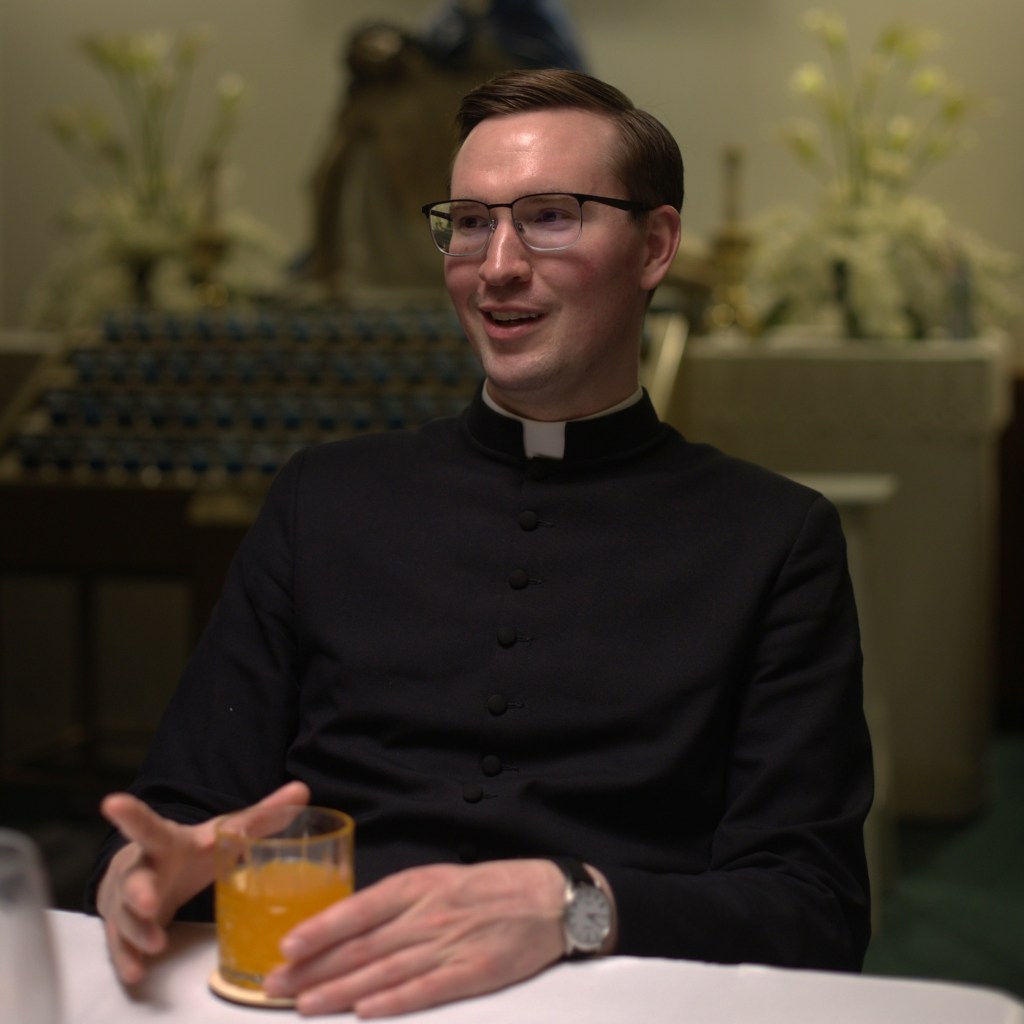
 Michael Smolders