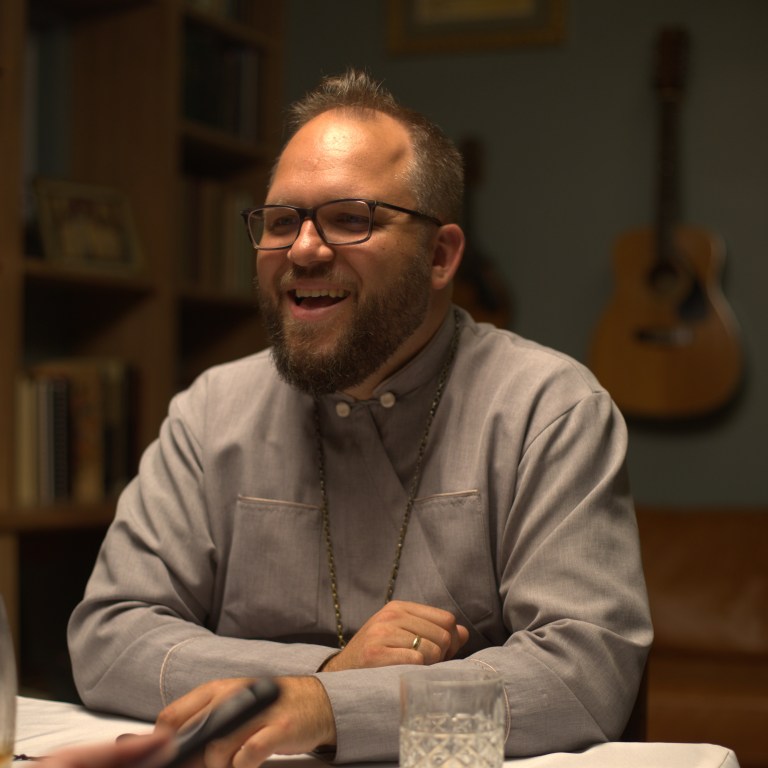
Father Tom Hrywna is a Catholic priest. He says so plainly. But he is wearing a cassock and a pectoral cross instead of a Roman collar, and when he describes his church, he offers a gentle warning: walk into one of his liturgies and you will swear you have wandered into an Orthodox church. The incense, the icon screen, the leavened bread stamped with Greek letters — Jesus Christ conquers — none of it looks like a suburban parish Mass.
“You’d say, but this is Catholic,” he laughs, “and I’d say, yes.”
Father Tom is a priest of the Ukrainian Greek Catholic Church, one of twenty-three Eastern Catholic churches in full communion with Rome, each carrying its own liturgical and spiritual patrimony like a language spoken inside the same family. His is the Byzantine Rite, its roots reaching back to the year 988, when the lands that are now Ukraine first received the faith. It is, as he describes it, a church forged in fire — martyred after its 1596 reunion with Rome, driven underground by the Soviets, who told its bishops to renounce their church or go to Siberia. Many chose Siberia. For over forty years it was the largest illegal organization in the Soviet Union, its faith kept alive in secret. Perseverance, it turns out, is written into Father Tom’s spiritual DNA.
But the story he most wants to tell is smaller and closer to home. It begins in a sixth-floor apartment in Toronto with a woman who did not speak English.
Baba’s classroom
His grandmother — his Baba — is the reason, he says, that he owes so much of his faith. He remembers a summer when he was in grade two, thrilled that school was out and nothing was required of him. His Baba had other plans. “You’re going to learn the Creed,” she told him, “in both Ukrainian and English.” She could not read the English herself, but she sat him down and made him memorize it anyway.
She never missed the Moleben, the short May prayer service to the Mother of God at the church two doors down. At 6:45 they would take the elevator down and go. To this day Father Tom can sing that entire service from memory in Ukrainian — not because he studied it, but because his Baba sang it at home while she moved about the apartment.
That was the warmth of it. The rest of his boyhood faith, he admits, was more surface than soul. He was an altar server, enamored with the vestments and the swinging censer — “look at all this great stuff” — but not always present. A deacon at his parish would put the question to him with surgical kindness: “Thomas, were you in church today, or were you at liturgy?” He could stand in the building as long as he liked. That was not the same as being at the altar of God. “My mind was somewhere else,” he confesses. “When can I go home and play video games?”
And yet the thought of priesthood kept surfacing, quiet and persistent, even through the years he wasn’t really listening.
“You’re too young. Go get a degree.”
At eighteen he was ready. He marched to his pastor and announced he was going to seminary. His pastor — one of the two great influences on his priesthood — looked at him and said, flatly, “No, you’re not.” Why? “You’re too young. Go do a degree.”
So he did. He went to the University of Toronto for political science, imagining a life in law, tucking philosophy courses into his schedule “just in case things change.” He never fully put the seminary out of his mind; he simply set it down. Meanwhile he stayed close to the Church — the pro-life group at St. Basil’s, two World Youth Days, a season of discernment with the Redemptorists, drawn by their brotherhood and their service to the poor. Somewhere in those years, watching priests make hospital visits and sit patiently with a twenty-year-old who talked too much and knew too little, he began to see past the incense to the love underneath it.
By late 2011 his degree was finished. In January 2012 he packed his room into his car and drove to the seminary in Ottawa.
The double discernment
His rector handed him a piece of wisdom he has never forgotten. “You are discerning two different things,” the rector said. “Celibacy or marriage — and priesthood or no priesthood. They are not bound together.” In the Eastern churches, married men can be ordained. Father Tom entered fully expecting to become a celibate priest. He did not want to be celibate — but a few relationships hadn’t worked out, and he had made his peace with it.
Then came a young American woman studying canon law. She’d chosen Canada because it was cheaper than Washington. She’d landed a residence room with a Ukrainian priest’s daughter who brought her along to the Eastern liturgy, and she had fallen for its beauty — and, it turned out, for the oblivious seminarian serving at the altar. She messaged him for two months. He assumed she was interested in the East. “She was interested in you,” the interviewer laughs. By February they were dating.
He remembers telling his spiritual director he thought he was called to celibacy. A few weeks later: “I’m dating a girl.” When she phoned her mother to explain, her devout Roman Catholic family — who had never heard of any such thing — needed convincing. “Don’t worry,” she assured them, “the Pope’s fine with it.”
Two mothers’ prayers hover over this story. His future mother-in-law had prayed for a priest son — and, as Father Tom jokes, “wasn’t specific enough to say one of my two sons.” And his own mother, decades earlier, had dragged a four-year-old Tom into a packed church for a newly ordained priest’s first liturgy. Seeing the radiant joy on the face of that priest’s mother in the front row, she prayed: Lord, could I be that joyful one day?
Grace supplies what is lacking
They married in May 2014. He was ordained the following year, the bishop’s hands on his head, the ancient words settling over him: Divine grace, which always heals that which is infirm and supplies that which is lacking. “Eleven years later,” he says, “the Lord has supplied a lot of what I lack.”
His first parish, in Windsor, came with a $3.2 million mortgage and a twenty-six-year-old pastor younger than his parishioners’ children. He rolled up his sleeves. On Wednesday mornings he hauled three hundred pounds of potatoes so the retirees could make pierogies. His three daughters were all born there. When the bishop later moved him to a two-thousand-member parish in Mississauga, the work swallowed his family whole. A move to a smaller parish followed, and with it a quiet gift: “I’ve had dinner with my wife and kids more in one month here than in a whole year there.”
His family, he insists, does not compete with his priesthood — it is his priesthood. His wife carries a real title in the Eastern tradition; women in the parish often find it easier to speak with her. His first vow of obedience, he says with a smile, is to her.
As Vocations Director now, he worries about the thinning ranks — seminary classes of seven or eight, a world that sells young men power and glory and calls a life of service foolish. But he has watched too much perseverance to despair. He fingers his prayer rope of one hundred knots, switching from English to Ukrainian at the gap, and prays the prayer that has held his church together through fire:
Lord Jesus Christ, Son of God, have mercy on me, a sinner.