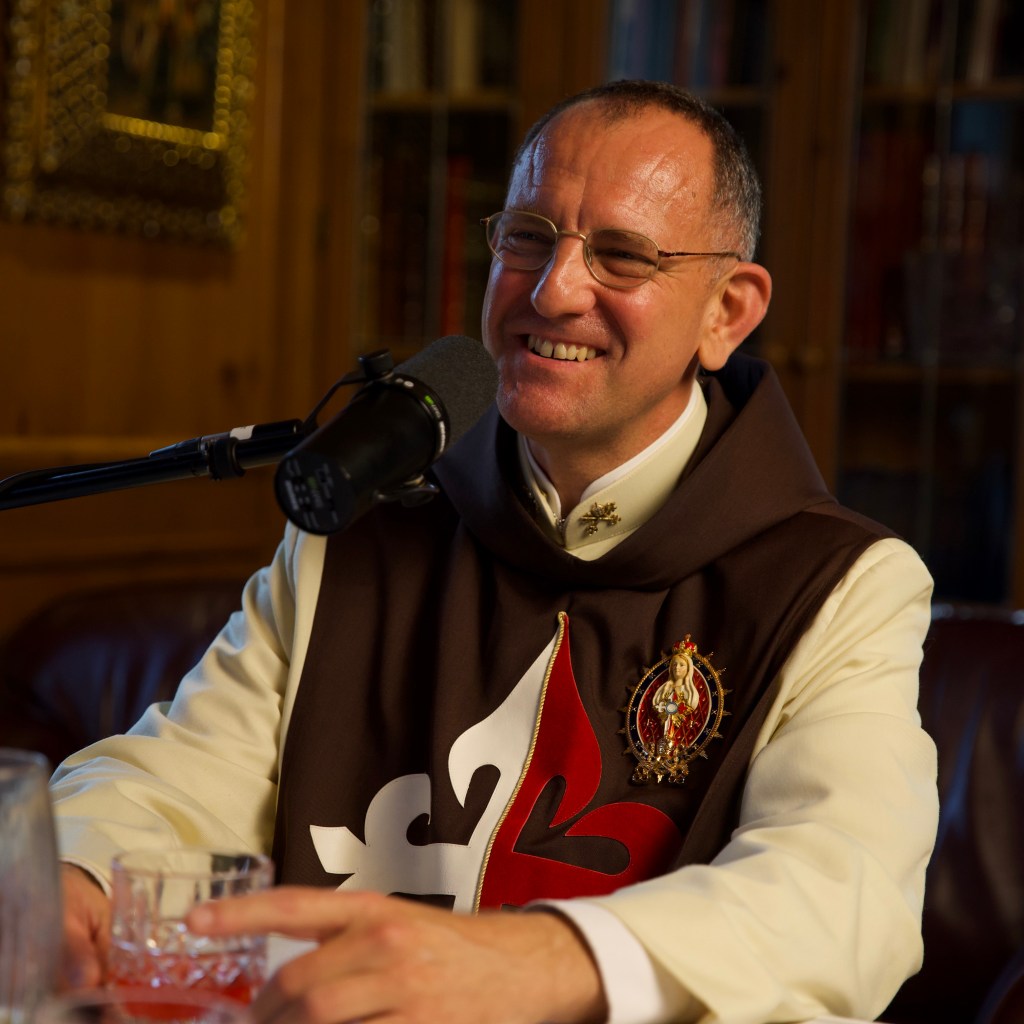
Some stories begin with a trumpet, some with a whisper, and a good many, if we are honest, with a mistake. Brother Gustavo’s story has all three, though the trumpet came last and he did not hear it for years.
The whisper came first. It was spoken on a dark road in Argentina at two o’clock in the morning, by a young mother who had just been thrown clear of her family’s wrecked car. Her husband had died on the spot. He was a medical doctor and an army captain, the latest of five generations of soldiers. Her son, four and a half years old and covered in blood from the broken glass, was still inside. And she said the only thing she had trained her heart to say: “Mary, help us.”
She pulled the boy free. A truck came out of the empty dark and carried them both to the hospital. Years later the boy looked up the date, the 27th of November, and found it was a feast of Our Lady of Graces. He has never thought that a coincidence.
His mother also taught him something without ever saying it. In the great moments of life, he says, we do not rise to the occasion. We fall to the level of our training. She had prayed to Our Lady so often in ordinary hours that, when the terrible hour came, the prayer was simply there, waiting like a coat on a hook by the door.
That night left him an only child. For the rest of her life his mother made one steady act of faith about it: I do not understand this, but God has it.
His family had lost things before. His grandparents fled Slovenia after the First World War. They were stateless, and their farm had been taken. His grandfather’s last sight of his own father was at a train station: a lieutenant among the soldiers, pressing a little sugar and coffee into his son’s hands. Then the train pulled away for good. Gustavo comes from people who knew how to lose everything and keep walking.
His grandmother, a woman with firm military views, moved him to a Salesian school ten blocks away. One morning when he was about eight, he walked into the chapel there and understood all at once what was in the tabernacle. Oh. This is the Heart of Jesus. He is actually here. Then Saint John Bosco took him by the hand, as he takes every boy, and led him straight to Mary, Help of Christians.
A boy without a father has to learn to fend for himself, and as a teenager Gustavo took up karate. He liked the discipline. He liked learning that pain is not a monster. It is more like weather: it comes and goes, and you learn to get through it. And without his knowing it, karate led him to the door of his whole life.
That brings us to the mistake. At a tournament in 1986, nervous before one of his first fights, he made friends with some boys who invited him to “come join us.” They all trained hard, so he assumed they meant a gym. He went along, walked in, and found a statue of Our Lady. Then came catechism, before anything else. Then the Rosary. Then he met seventy or eighty young men who had decided not to waste their lives the way so many people around them were wasting theirs.
It was not a gym after all. Or rather, it was a gym of a different kind, where the muscle being trained was the soul. These were the early Heralds of the Gospel, though they did not yet have the name.
He played in a rock band, too, and he loved those friends. But a day came when he saw that he could not stand in the middle forever. “Listen, guys,” he told them, “I’m not going with you.” It hurt. We seldom give up bad things for good ones. More often we give up good things for better ones, and that is why it hurts.
He had always meant to be a soldier, like the men before him. Then he discovered Fatima, and Our Lady’s promise that in the end her Immaculate Heart would triumph. This was the trumpet. It was not a vision, he insists, just “regular Catholic inspiration,” but it was as clear as a voice across a room: The world is falling apart. I am going to help it. What are you going to do for me?
So the soldier’s son found his regiment after all.
His mother was less sure. “Can you explain this?” she asked. What could he say? There were no basilicas then, no seminaries, no habits, not even a name. “It’s a blueprint, Mom,” he told her. “It’s a blueprint.”
He finished his gruelling Salesian trade school and put engineering aside for good. In 1989 he went to the community’s house in São Paulo, Brazil. He did street missions with books about Our Lady and listened to Gospel meditations on cassette tapes, passed from house to house until they wore thin. In 1994 a superior was sent to Canada and chose, Gustavo says with a grin, “the worst, the most troublesome” three men to go with him. Gustavo was one of them. In 2001 he stood in Rome when Pope John Paul II gave the Heralds pontifical approval. The blueprint was becoming stone.
Years later his mother said to him, quite calmly, “It was me who told you to join, remember?”
“Yes, Mom,” he said. “Of course.”
Ask him now, after more than thirty years in Canada, what it has all been like, and you will not hear a man listing what he gave up. You will hear about joy.
Some of the boys who came to his first boys’ programs in Toronto now stand at the altar as priests, “in spite of us,” he says. Children at the school come up to thank him. And there is a quieter joy. If you help one young person make one good decision, that decision passes on to their children and grandchildren, down through generations you will never meet.
But the deepest joy is a kind of surprise. Whenever you give something to God out of love, he says, God steps into the space you have left. Give up speech for a monastery’s silence, and God himself begins to speak to you. Give up having children of your own, and God gives you many children. Be an only son who has to tell his widowed mother, “Mom, I have to go,” and God sends you more mothers than you can count. None of this is a bargain. You do not give so that God will give back. But one day you look around and say, “Where did all of this come from? Thank you, Lord.”
He likes to say that God sits on the edge of His throne, leaning forward like a father and wondering, What is he going to ask me? Why doesn’t he ask? The Heralds have a word for the answer God is waiting for: presto. Here I am, Lord. Ready.
The boy who walked into a gym and found Our Lady said it a long time ago. He has been saying it ever since, and it has made him glad.