There is a particular kind of divine comedy that operates not through a legion of angels but through the ordinary machinery of the postal service. Father Ignatius Saiki will tell you this himself, and he will tell you with the quiet amusement of a man who has had twenty-two years to appreciate the punchline.
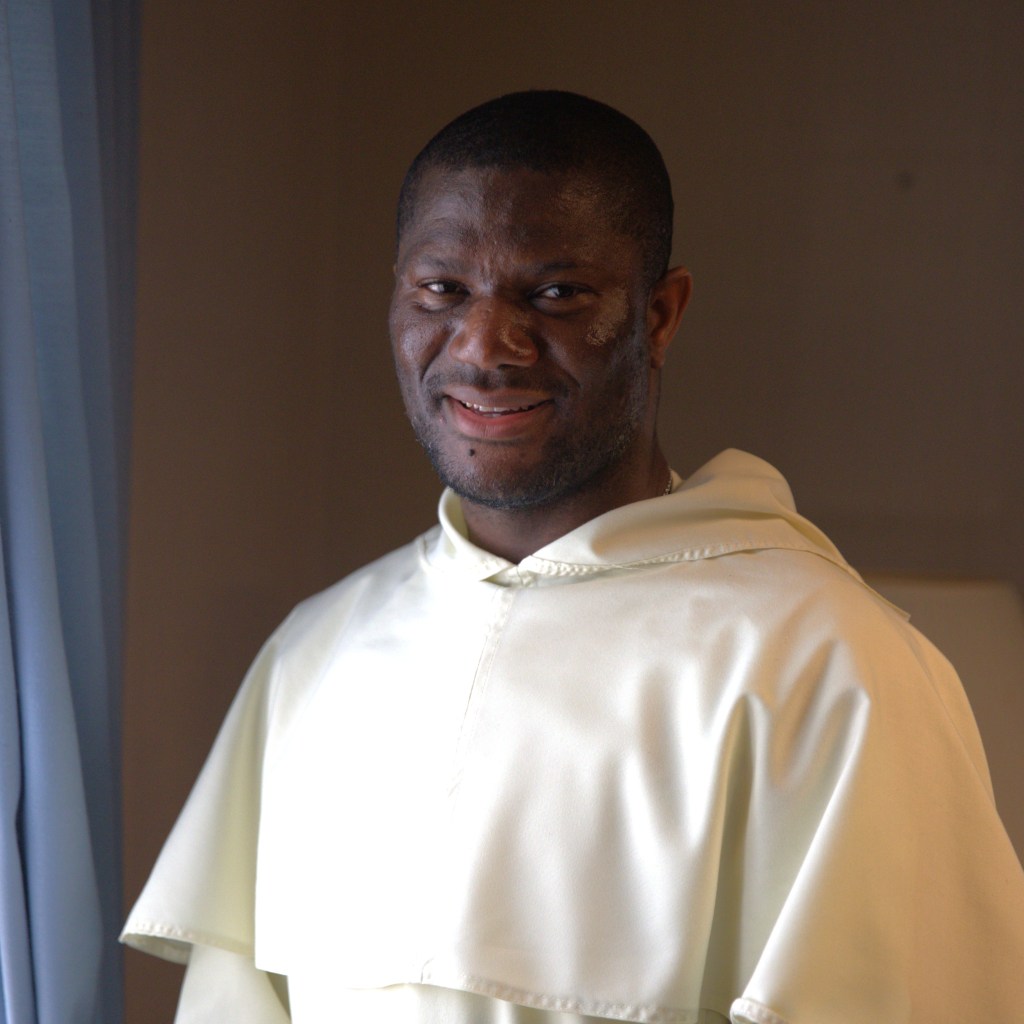
Father Ignatius is a Dominican priest. He did not intend to be one.
He is a Nigerian, a fact which would have surprised the men who were first sent as missionaries to the cold country of rural Ontario, Canada where he now preaches from. He seems to regard the irony with the gentle satisfaction of a man who has understood, over a long time, that God’s arrangements tend to be more elegant than our own.
The story of how he became a Dominican is really a story about a boy who loved his faith so completely that God could work with almost any material at hand. He was born on the feast of Saint Ignatius of Loyola, and his parents, in the custom of many Nigerian Catholic families, gave him that name. When he was old enough to read, he went to his father’s library and pulled down a book on the lives of the saints, went straight to July 31st, and discovered that his patron had founded the Society of Jesus. From that afternoon forward, he was going to be a Jesuit. He was as certain of this as he was certain of anything.
But the vocation came before the Jesuits did. From his earliest years, even before he fully understood what a priest was, he knew he wanted to be one. He watched the old parish priest arrive on the first Friday of every month to bring communion to his grandmother, who was too frail to come to church. He remembers the household waiting for that visit, the particular atmosphere it created, the sense that something important and real was about to happen in an ordinary room. It drew him as a calling draws the one being called.
After his first communion, he joined the Legion of Mary. This was where his love for the faith became something more than feeling — it became formation. He had to prepare. He went on house visits, knocked on doors, spoke to strangers about God’s love, and was occasionally sent away for his trouble. He met a Protestant minister who asked him, with the cheerful confidence of a man expecting to win, where Saint John was when he wrote the Book of Revelation. He did not know. He went home, found the answer — Patmos — and never forgot it. Each confrontation deepened his roots rather than shaking them.
By the time he finished secondary school, his older siblings and his science teacher had decided he was going to be a doctor. He was good in the sciences. He was diligent and serious. They were not wrong about his abilities. But there was something in him that they had not accounted for, something that had been growing quietly since the first Fridays of his childhood. He did not tell them. He was afraid that if he spoke, they would discourage him, and he was not yet sure he could withstand that. So he carried it with a quiet certainty.
He wrote three letters of application: to the Jesuits as his first choice, the Dominicans as his second, the Augustinians as his third. The Dominicans replied first. He set the letter aside. He was waiting for the Jesuits. The Augustinians replied. He set that letter aside too. A friend eventually persuaded him to answer the Dominicans, which he did with the mild compliance of a man humoring someone else’s suggestion. He went for the interviews, spent five days in the community, and was selected for the next stage. He went home and told his parish priest he was still hoping to hear from the Jesuits.
He waited. In October he was invited to begin at the Dominican house in January. He waited a little longer. Then, just before his departure date, the Jesuits finally sent him some forms to fill out. It was too late. He went to the Dominicans.
Twenty-two years later, he says without any trace of wistfulness that he is quite certain this is where God wanted him. Not as a consolation for what he missed, but as a conclusion he has arrived at through the evidence of his own life.
The evidence is considerable. The Dominican formation suited him in ways he could not have anticipated. The order is built on four pillars: prayer, study, common life, and preaching. These are not merely practices but a whole way of being. When Saint Dominic founded the Order of Preachers in the thirteenth century, only bishops were permitted to preach. He obtained from Rome the extraordinary permission for his brothers to preach without being bishops — on the condition that they were prepared. Thoroughly, rigorously prepared. Hence the years of philosophy, then four years of theology, the dissertations, the intellectual discipline that is not in tension with prayer but is, in the Dominican understanding, a form of it. To study the faith carefully is itself an act of love toward God and toward the people one will eventually serve.
Father Ignatius flourished in this. He describes the years of formation with a particular warmth — the moment when the things he had memorized as a child in catechism began to reveal their depths, when the words he had learned by rote turned out to have architecture behind them, reasons and roots and a coherence that, once seen, made everything more solid and more real. The faith he had received as a gift from his family he now possessed as his own.
There was one moment, early in the postulancy, when he very nearly left. His father died in February of the year he entered, having been well when his son departed in January. It was sudden. He was devastated. He could not understand how this could be a good sign. He spoke with a brother in the community who told him, gently and directly, that his father would want him to stay. He stayed. He believes now — not as sentiment but as conviction — that his father has been interceding for him ever since. After that, he says, everything was fine.
This is the shape that obedience takes in a life that has genuinely embraced it: not the grim submission of a man overruled, but the settled peace of a man who has learned to trust the wisdom of those placed over him. It is not a passive thing. He had his difficulties with superiors during the years of simple vows. There were moments when he thought his own judgment was better. There were things he would have done differently. He dialogued, as he was entitled to do. And then, when the determination came from above, he listened. Not because he was incapable of independent thought, but because he had understood something: that the vow of obedience is not an abdication of the self but an offering of it, the same offering that Christ made, which is why it carries the weight it does.
After his ordination in 2013, he was sent to a parish and made assistant vocations director for the Dominicans in Nigeria. He spent nine years in this work. He met young men who felt a pull they could not name, and parents who had made careful plans that did not include celibacy. He visited families. He made the argument, many times, that a child is not a possession but a gift, and that a gift can be returned to the one who gave it. The argument was not always immediately welcome. He made it anyway, with patience and without apology, because he believed it.
He asked his provincial, after those nine years, for permission to go to Rome for further studies — to the Angelicum, the Dominican university of Saint Thomas Aquinas. He had earned it, in any ordinary reckoning. The answer was no. He was needed in North America. There was a mission in Canada, a Diocese of Hamilton that had arranged a contract with the Nigerian Dominican province, a parish in Huron County where priests were scarce. He accepted this without drama. He had taken vows of obedience and he meant them, not as a formality but as a commitment to something he genuinely believed: that his superiors, in the ordinary course of their authority, could direct him more wisely than he could direct himself.
And so he came to Ontario. The same country that sent missionaries to Nigeria a century ago now receives one in return. The schools those missionaries built baptized families who raised children who raised him. The faith travelled south, took root, and has now sent something back. He regards this not as irony but as the ordinary operation of a Church that is, as he says, universal.
He was asked what families here can do to encourage vocations. He said the catechesis was poor — not the people, but the instruction they had received. They were not indifferent; they simply did not know enough to be on fire. He said that witnessing was essential, that people needed to see the faith lived out before they would be drawn to it. And he said that prayer was the foundation of everything, that it is God who calls and the rest of us who prepare the soil. He does not appear discouraged by the shortage of vocations. He prays for them, preaches toward them, and trusts that the same God who arranged for him to be a Dominican rather than a Jesuit is capable of arranging whatever else is needed.
Outside, the snow lay over Huron County in the particular silence of a Canadian winter. Inside, a Nigerian Dominican priest who grew up watching a parish priest bring communion to his grandmother, who joined the Legion of Mary and answered hard questions at strangers’ doors, who waited for a letter that never came and found his life in the one that did — this man prayed for the young men of this country, that they might hear a voice and have the courage to answer it.
He knows something about that courage. He has been practicing it for twenty-two years.
 Michael Smolders