He was called Adam because his parents liked the name. That is a small, ordinary fact; it is also the kind of beginning that suits a vocation—nothing theatrical, only a name and a family, and then a slow accumulation of moments that mean more than they first appear.
Adam Pantaleo grew up in Mississauga, Canada in a home that was nominally Catholic. His parents had him baptized and brought him for first Communion and confirmation, and then life went on. There was not a house of prayer; there were no regular family devotions. Still, the sacraments were seeds. One memory stayed with him: sitting in a church as a six‑year‑old and feeling a peculiar peace. He could not explain it then. That feeling was like a very small lamp kept lit in a dark room.
He was good at science. He studied Integrated Science at McMaster and then did a master’s in synthetic and organic chemistry at the University of Toronto. The laboratory suited him—order, predictability, disciplined repetition. He found a kind of wonder in molecules and laws of nature. For him, science and faith were not enemies; they occupied different places and together pointed toward the one True. In philosophy year at seminary, he would later learn to see them in their proper relation. But in university he simply loved the work, even when experiments failed thirty times.
His return to regular practice was gradual and strangely providential. While commuting to school, he started to sit in the back pew again. One unexpected morning his parents insisted—without warning—that the family go to Holy Mass. Adam resisted, then sat. He made a half‑formed promise to try coming back. He missed Sundays, he was imperfect, but the habit began. He started going to Holy Mass regularly, then found the campus chaplaincy. The Newman Center was three or four minutes from the chemistry building. He began to join faith studies, to meet people, to lead discussions, and slowly his desire for the life of the Church deepened.
The shift away from a scientific career was not a sudden conversion scene. He applied for grad school and entered the momentum of academia, but his enthusiasm waned. Seminary or priesthood was not the immediate thought; the first honest decision was simply not to pursue a PhD right away. He created space—tutoring chemistry, stepping off the highway of expectations—to listen. The feeling that he ought not keep the faith only to himself grew: prayer and Mass could not remain merely private.
He told a parish priest, Father Kim D’Souza, in a halting way: “Something weird is happening.” That priest’s openness—an offer to talk and an encouragement to contact the vocations office—was decisive. When Adam sat down to tell his parents properly, they were surprised. They loved him and did not oppose him, but they had trouble imagining the priesthood for their son. They asked the usual questions—what about marriage, grandchildren, a secure career—and offered more familiar alternatives. They were not unsupportive; they were puzzled and cautious. With time, illness, prayer, and patience they came around.
Seminary proved to be a long, slow forming. He stresses that priesthood is learned in time: the promises, the discipline, the interior changes do not happen like magic. Celibacy, obedience, perseverance—each is a work of years. He relates that months before ordination he experienced severe doubts, a kind of spiritual warfare that many men encounter. In moments of desperation he cried out to the Lord and received signs that helped him move forward. There were no grand, constant revelations; mostly there were small confirmations that built trust.
His pastoral life is both ordinary and extraordinary. He rises early to pray before the Blessed Sacrament, to ground himself. He divides his day into units—work, prayer, rest—to avoid burning out. He visits schools, brings vestments to children, answers questions, and prepares homilies. He cares for marriages preparing for baptism, for families seeking counsel, for hospital visits and funerals. He presides at liturgies and finds that the experience of leading a Good Friday service, for instance, is different in a way that surprises him: theory becomes a lived sacrament.
Confessions carry a particular weight. He found them crushing at first; hearing people’s brokenness face to face was a burden that required walks and time to breathe. Over time the shock lessened—he has heard many confessions and nothing surprises him now—but the wonder and the fruit remain. He has witnessed deep conversions and knows the confessional as a place where great grace can happen.
Loneliness is real in the priesthood. He does not pretend otherwise. Yet he insists he is not alone: the Lord is with him in a special way required by the vocation, and he has brother priests, parishioners, and friends. He is, by temperament, an introvert; he enjoys visits and invitations but needs time for prayer and rest. He also keeps a regular confessor—his spiritual director—and recommends that priests receive confession themselves. Spiritual direction, he says, is a continual formation.
When asked what draws others to consider priesthood, he returns to practical, simple truths. Parents should keep their promises at baptism: raise their children in the faith, pray as a family, go to Holy Mass. Even if they have failed before, it is never too late to begin again. Be open when a son or daughter expresses an interest in consecrated life—do not mock or immediately shut it down. For parish priests, he asks only this: be open and encouraging. If a young man hints at a vocation, listen gently, make time to speak, and point him toward formation. The parish that honours the Eucharist, prays for vocations, and practices hospitality will tend to bear fruit.
He gives a simple litmus for priests and parishes hoping to foster vocations: celebrate the liturgy reverently and preach well. Programs and pamphlets have their place; they do not replace holiness, presence, and sincere preaching. Hospitality matters: notice the shy person in the back pew, invite them for coffee, let them be seen. The ordinary practices of parish life—prayer, sacrament, welcome—are the soils from which vocations most often grow.
His own family taught him hard lessons. His father’s illness—early‑onset Alzheimer’s—became a crucible. Watching his mother care for his father taught Adam the sacrificial fidelity that marriage entails and shaped his understanding of pastoral love. He anointed his father a week before he died and celebrated the funeral mass; these acts were among the most difficult he has performed and among the most formative.
There is no showmanship in his account. He does not promise fireworks. He has one cassock, a practical clerical shirt, a taste for good homilies and good confessionals, and a steady love for the Eucharist. He asks for prayer for laborers in the harvest and for perseverance for those who have already said yes. He knows that God calls, not the world; that vocations are invitation and gift; and that the most useful things are often small: a welcoming word, regular family prayer, a priest who will listen without haste.
Thus the story is not heroic spectacle but an ordinary trail of light: a child who felt peace in a church, a scientist who learned that truth wears many garments, a young man who made room to listen, a family who learned again how to pray, a priest who takes the weight of confessions and the joy of the Mass and who, day by day, tries to be faithful.
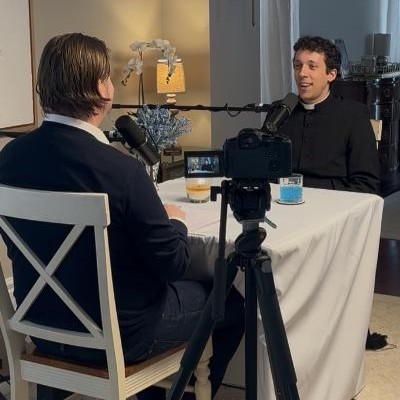
 Michael Smolders